

 Blog
Blog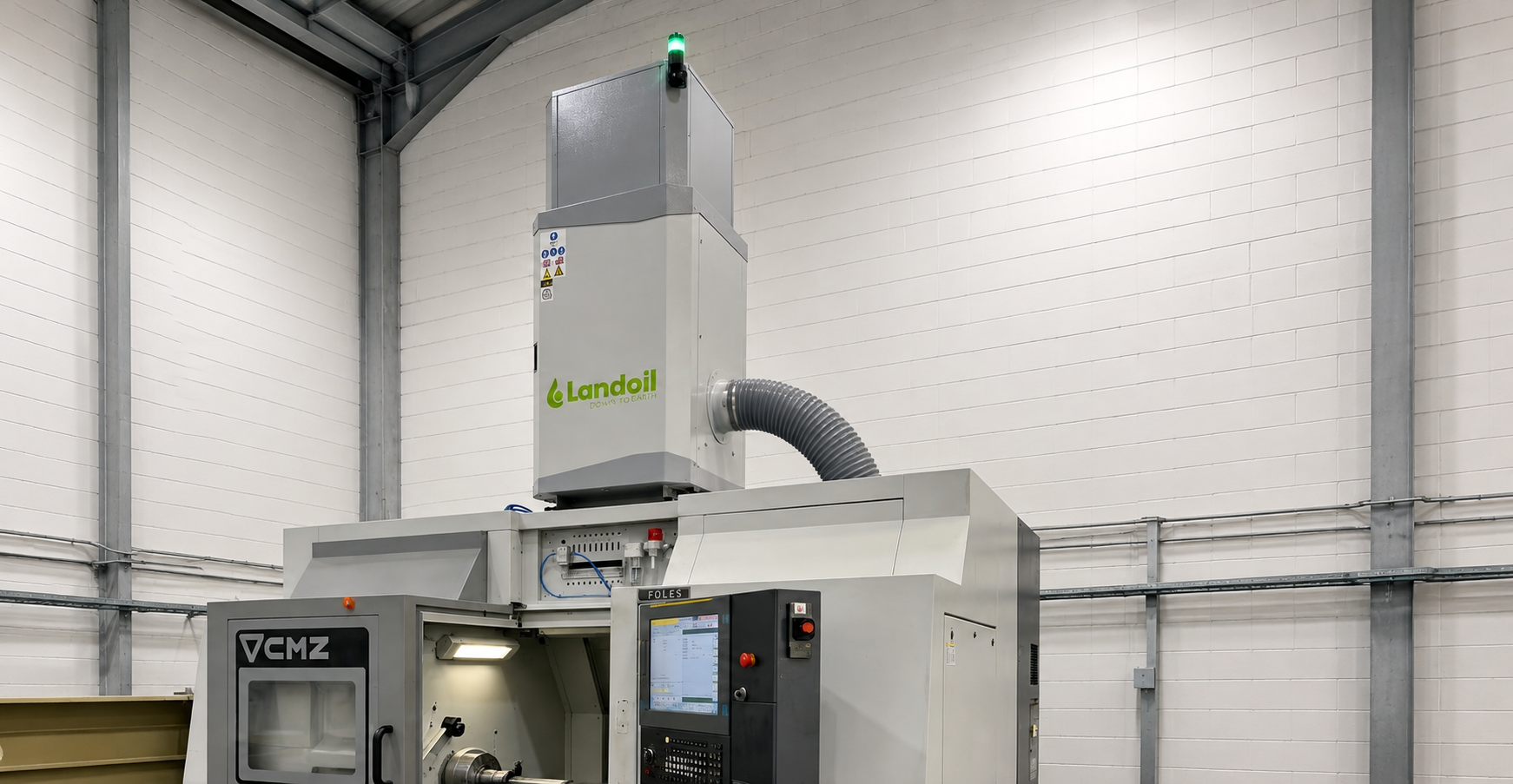
In modern machine shops, air quality is an aspect that is often overlooked. Attention is usually focused on machine tool productivity, machining precision, tool life and the quality of the coolant. However, during chip-removal machining processes such as turning, milling, grinding, drilling or high-speed machining, a phenomenon occurs that can have a significant impact on operators’ health and workplace safety: the formation of oil mists.
Oil mists, also known as oil aerosols or coolant mists, are liquid microparticles suspended in the air. They form when pure oils, emulsions, semi-synthetic or synthetic fluids are atomised during the machining process. The high spindle speed, the pressure of the coolant, the impact of the jet on the workpiece, the rotation of the tool and the temperature generated by the cutting process all contribute to the dispersion of tiny droplets into the surrounding environment.
At first glance, they may seem like a mere nuisance: a light mist around the machine, greasy surfaces, lingering odours or stuffy air in the workshop. In reality, if not managed correctly, oil mists represent a much broader issue, affecting health, safety, industrial hygiene, production efficiency and the overall quality of the working environment.
What are oil mists and how are they formed?
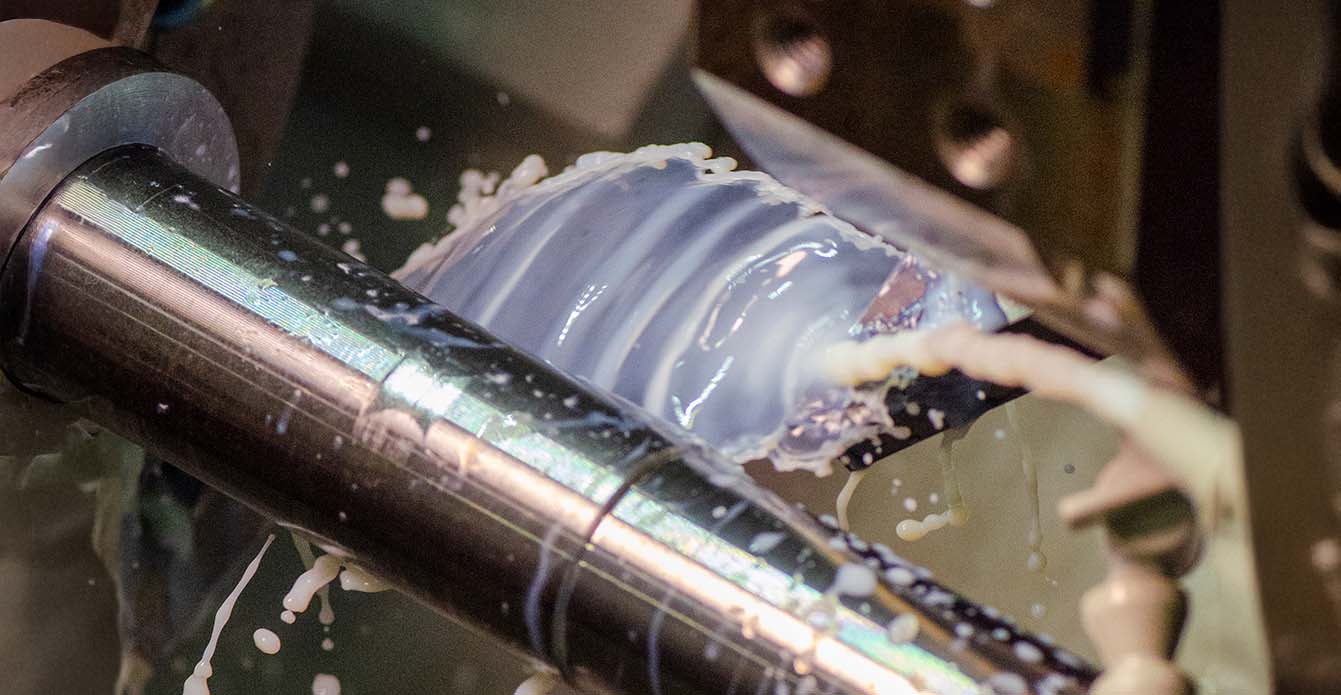
During machining, the coolant is designed to cool the cutting zone, lubricate the interface between the tool and the workpiece, remove swarf and protect both the machine and the workpiece from undesirable phenomena such as overheating, wear and corrosion.
However, when the fluid is sprayed at high pressure or comes into contact with rapidly moving parts, some of it is broken down into very small particles. These particles can remain suspended in the air and spread beyond the immediate vicinity of the machine.
This phenomenon is particularly evident in the following situations:
- enclosed CNC machines that are not properly ventilated;
- high-speed machining operations;
- grinding operations;
- deep drilling;
- turning operations with a high coolant flow rate;
- the use of non-water-based oils;
- contaminated or degraded emulsions;
- coolant tanks that are not cleaned regularly;
- high-speed spindle systems;
- high coolant pressures.
The more vigorous the machining process, the greater the likelihood that the coolant will be converted into an aerosol. If the machine is not fitted with an effective extraction system, these particles can escape from the enclosures, disperse throughout the workshop and accumulate in the air breathed by operators.
An invisible but persistent problem
One of the most critical aspects of oil mists is that they are not always immediately perceived as a risk. In some cases, their presence is obvious: a haze is visible inside the workshop, surfaces near the machine become greasy, operators’ goggles become dirty quickly, and the smell of oil becomes persistent.
In other cases, however, the contamination is less visible. The air may appear normal, yet still contain airborne particles. This makes the problem insidious: exposure can be daily, repeated and prolonged over time.
The machine operator is often the person most at risk. They spend many hours near the machine, opening and closing the guards, checking the workpiece, changing tools, cleaning the work area and monitoring the machining process. If the air around the machine is contaminated with oily aerosols, exposure becomes part of their normal working routine.
The risk does not only affect those working directly on the machine. In workshops with multiple workstations, without adequate localised extraction, mists can spread throughout the environment and also affect other operators, maintenance staff, quality control personnel or passing staff.
Health risks to operators
Oily mists can enter the body mainly via three routes: inhalation, skin contact and contact with the eyes and mucous membranes.
The most serious route is inhalation. The finest particles can be breathed in and reach the airways. Depending on their size, the composition of the fluid, the concentration in the air and the duration of exposure, they can cause irritation and respiratory problems.
Possible effects associated with uncontrolled exposure include:
- irritation of the nose, throat and respiratory tract;
- coughing;
- a sensation of stuffiness;
- breathing difficulties in more sensitive individuals;
- worsening of pre-existing respiratory conditions;
- bronchial irritation;
- discomfort during prolonged periods in the workshop.
The problem can become more significant when the coolant is degraded or contaminated. An emulsion that is not properly managed may contain bacteria, organic residues, foreign oils, metal particles and degradation products. In such cases, the aerosol is not composed solely of coolant, but may carry a more complex mixture of substances and contaminants.
Effects on the skin, eyes and mucous membranes
In addition to inhalation, oily mists can settle on the skin, clothing, eyewear and work surfaces. Repeated contact with cutting fluids and aerosols can contribute to irritation, particularly in the case of sensitive skin or skin already exposed to detergents, oils and other chemicals.
The hands, face, neck and forearms are the areas most commonly affected. In some situations, skin dryness, redness, itching or contact dermatitis may occur. The risk increases if operators work without adequate protective equipment, if clothing remains saturated or if hygiene procedures are not sufficiently rigorous.
The eyes may also be affected by the presence of oily mists. The aerosol can cause a burning sensation, watery eyes, irritation or discomfort, particularly when the area is poorly ventilated or when the operator frequently opens the machine immediately after machining.
These effects must not be underestimated. Even when they do not manifest as acute symptoms, they are signs of a working environment that may not be properly controlled.
Oily mists and workshop safety
The presence of oil mists does not only affect operators’ health. It can also impact the general safety of the workshop.
Over time, as oil microparticles settle, they create greasy films on floors, machinery, control panels, workbenches, casings and metal surfaces. This can increase the risk of slipping, make cleaning more difficult and worsen the general tidiness of the environment.
A workshop with air saturated with oil aerosols may experience:
- more slippery floors;
- dirty and greasy machine surfaces;
- reduced visibility inside engine casings;
- persistent odours;
- increased dirt build-up;
- the need for more frequent cleaning;
- reduced comfort for operators;
- a general perception of an unhealthy environment.
Furthermore, the presence of oil dispersed in the environment can contribute to the soiling of sensors, electrical components, lamps, panels and control devices. Over time, this can also affect machine maintenance and the overall cleanliness of the facility.
Why simply closing the cowlings is not enough
Many modern machine tools are fitted with enclosed cowlings. This certainly provides a first level of containment, but it is not always sufficient.
During machining, a mixture of air, vapour, aerosols, micro-droplets and particles carried by the coolant flow is created inside the machine compartment. If this mixture is not extracted and filtered, it remains concentrated inside the machine. When the operator opens the guard to check the workpiece or intervene during machining, some of the mist may suddenly escape into the environment.
Furthermore, if the machine is not perfectly sealed, the mists can gradually escape through gaps, openings, cable entry points, chip conveyors or areas that are not properly sealed.
For this reason, the cover must be regarded as a containment measure, not a complete solution. The extraction and filtration of contaminated air are essential steps to effectively reduce the dispersion of oil mists in the workshop.
The role of oil mist extractors and scrubbers
Oil mist extractors, or oil mist scrubbers, are systems designed to capture the contaminated air generated during machining, separate the oil particles and return filtered air.
Their function is to act directly at the source of the problem. Rather than allowing the aerosol to disperse into the environment, the mist collector creates a controlled negative pressure inside the machine or in the emission zone, extracting the mists before they can spread throughout the workshop.
The principle is simple, yet extremely important: capturing the pollutant as close as possible to the point where it is generated.
A correctly sized system can help to:
- reduce the concentration of oil mist in the air;
- improve the quality of the working environment;
- protect operators’ respiratory tracts;
- limit oil build-up on surfaces and floors;
- reduce odours and stuffy air;
- keep the machine cleaner;
- improve staff comfort;
- support safer management of the workshop.
How an oil mist collector works
Operation may vary depending on the technology used, but in general, a collector draws in contaminated air and passes it through one or more stages of separation and filtration.
The most common technologies may include:
- centrifugal separation;
- mechanical filters;
- coalescing filters;
- high-efficiency filters;
- electrostatic systems;
- final stages for micro-mist or fumes;
- systems for draining collected oil.
In mechanical and coalescing systems, oil particles are intercepted by the filter material, aggregate together and are separated from the air flow.
The collected oil can then be drained off, whilst the filtered air is discharged according to the system’s configuration.
The choice of technology depends on several factors: type of machining operation, type of fluid used, machine volume, quantity of aerosol generated, presence of fumes, required air flow rate, production continuity and the level of filtration required.
Not all applications are the same. Emulsion grinding, turning with pure oil and high-speed milling can generate contaminants that differ in quantity, size and composition. This is why it is important to choose a mist extractor suited to the specific process.
Health protection starts with prevention
Installing an oil mist extractor does not simply mean adding an accessory to the machine tool. It means tackling a source of daily exposure.
In a workshop, prevention should not be limited to the use of personal protective equipment. Face masks, gloves, goggles and suitable clothing are important, but they cannot replace proper control of the pollutant at source.
The most effective approach is to reduce the presence of contamination in the environment before the operator even comes into contact with it. A correctly sized extractor works precisely in this way: it limits the dispersion of aerosols, improves the quality of the air breathed and helps to create safer working conditions.
For the machine operator, this can translate into a tangible benefit. Less contaminated air means less exposure during the shift, less respiratory discomfort, fewer lingering odours, less contact with oily particles and a cleaner workstation.
Oil mists, comfort and productivity
Operators’ health is the main consideration, but not the only one. A cleaner, more breathable working environment also affects comfort and productivity.
Working for many hours in a workshop with stuffy air, the smell of oil and greasy surfaces can lead to fatigue, discomfort and a lower perceived quality of the environment. Conversely, a well-ventilated and clean workstation conveys a greater sense of order, control and professionalism.
This aspect is particularly important in modern workshops, where competitiveness depends not only on the machinery installed, but also on process organisation, the quality of the workplace and the ability to retain skilled staff.
A healthier workshop is also a more attractive workshop. Operators can tell the difference between a machine that releases mist every time the sump cover is opened and one fitted with an effective extraction system. This difference affects the quality of the working day.
The coolant must also be managed correctly
An oil mist eliminator is essential, but it must form part of a comprehensive and correct coolant management system.
A fluid that is degraded, contaminated or maintained at an incorrect concentration can cause a number of problems: unpleasant odours, instability, microbial growth, increased residue formation and a deterioration in hygiene standards. Consequently, the quality of the aerosol generated may also deteriorate.
This is why it is important to combine the extraction system with good tank management practices:
- regular checks on concentration;
- correct topping up;
- removal of foreign oils;
- cleaning of the tank base;
- replacement of the fluid when necessary;
- use of suitable water;
- monitoring of odours and the condition of the emulsion;
- regular maintenance of the machine.
Air quality in the workshop does not depend on a single factor, but on the balance between the machine, the fluid, the process and the extraction systems.
Maintenance of the oil mist extractor: an aspect not to be overlooked
An oil mist extractor must be selected correctly, installed correctly and maintained correctly. A neglected system may lose efficiency over time, reducing its capture and filtration capacity.
Maintenance may include:
- checking the filters;
- cleaning or replacing the filter elements;
- checking the air flow rate;
- checking the drainage systems;
- checking for any blockages;
- checking the pipework;
- inspecting the seals and extraction points;
- checking that the fan is operating correctly.
An oil mist extractor should not be regarded as a ‘fit-and-forget’ system. Like any technical component integrated into the production process, it requires regular checks. Only in this way can it maintain, over time, the performance necessary to protect the working environment.
When to consider installing an oil mist extractor
The installation of an oil mist extractor should be considered whenever a machine tool generates visible or perceptible aerosols, but not only then. Even in the absence of an obvious cloud, it may be advisable to analyse the conditions of the environment, especially if operators report discomfort or if surrounding surfaces are often greasy.
Some signs that should not be ignored are:
- visible mist around the machine;
- mist escaping when the casing is opened;
- a persistent smell of oil or coolant;
- oily deposits on the machine and floor;
- goggles or visors that become dirty quickly;
- irritation to the eyes, throat or skin;
- stuffy air in the workshop;
- the frequent need to clean surfaces near the machine;
- the presence of many machines operating simultaneously.
In such cases, a mist abatement system can provide a practical solution to improve air quality and reduce operators’ exposure.
An investment in safety and workplace quality
Oil mist extractors are often regarded as an additional cost. In reality, they should be viewed as an investment in safety, production continuity and workplace quality.
A clean, tidy workshop with controlled air quality reduces problems linked to the build-up of contaminants, improves operators’ comfort and helps to maintain the overall condition of the machinery. The presence of effective extraction systems also demonstrates a commitment to the people who work alongside the machinery on a daily basis.
Protecting operators’ health is not merely a matter of complying with a legal obligation. It means recognising that the quality of production also depends on the quality of the environment in which that production takes place.
Conclusions
Oily mists represent a real problem in mechanical workshops that use machine tools and coolant fluids. They may seem like a side effect of machining, but in reality they affect operators’ health, workshop safety, the cleanliness of the machines and the day-to-day comfort of those working there.
Ignoring the problem means allowing aerosols, micro-droplets and contaminants to spread into the environment, increasing operators’ exposure and progressively worsening air quality. Conversely, taking action with extractors and oil mist scrubbers allows the pollutant to be controlled at source, reduces dispersion and creates healthier working conditions.
A properly sized extraction system, combined with correct management of the coolant and regular maintenance, represents a highly valuable technical and preventative measure. It does not merely protect the machine or the workshop: above all, it protects the people who work in close contact with the production process every day.
Improving air quality in the workshop means improving safety, the quality of work and the sustainability of the entire production environment.
 Practical guide